Portable Oxygen Concentrator Features Explained: What Matters for Everyday Life
$15 Off
Enjoy special offer
CODE:VRBLGDC20
COPY
CODE
Quick take: Compare a portable oxygen concentrator (POC) by its delivery mode, carrying weight with the battery, stated battery runtime, and included power accessories. Then consider how its bag, controls, and charging options fit everyday activities.
Last editorial fact-check: October 29, 2026. Product specifications and accessory bundles may change after this date.
Two portable oxygen concentrators can look alike in product photos yet feel different to pack, power, and manage during a normal day. On a grocery trip, a family visit, or an afternoon at a desk, the practical questions are simple: What goes in the bag? Where is a compatible power source? Can you see the display without unpacking the unit? This portable oxygen concentrator comparison connects published weight, battery, AC/DC power, noise, controls, and support details to those everyday decisions.
The Features That Matter Most—At a Glance
Use this table as a checklist when comparing product pages. The field names vary by manufacturer, so look for the information itself rather than relying on one exact label.
Feature
Why it matters in everyday life
What to look for on the product page
Delivery mode
Pulse-flow and continuous-flow descriptions are not interchangeable.
“Oxygen Delivery Mode,” “Flow Mode,” or the model’s instructions
Carrying weight
The unit may weigh more when a battery and carrying accessories are added.
“Net Weight (with battery)” or a clearly defined weight basis
Battery runtime
“Up to” time may apply only to a particular setting or battery.
“Battery Working Time,” setting range, battery type, and test conditions
Power options
A wall adapter, vehicle cable, and removable battery serve different situations.
“Power Supply,” “Package List,” and compatible accessory details
Carrying design
Bag openings, straps, handles, and access to controls affect convenience.
Included carrying case and the manufacturer’s carrying instructions
Noise and controls
Published sound levels and display details are useful only when the conditions are clear.
Noise level and setting, display images, and the user manual
Ownership support
Replacement parts, maintenance instructions, and warranty terms affect long-term use.
Manual, accessory listings, maintenance guidance, and current warranty policy
On VARON product pages, examples of useful fields include “Net Weight (with battery)” on the VP-8G page and “Battery Working Time” on the VP-8 Lite page. Other models may use different labels. Compare the details shown for each exact model and bundle, rather than assuming that all products use the same specification format.
Pulse Flow vs. Continuous Flow: A Plain-English Distinction
A pulse-dose device releases oxygen in pulses rather than as a continuous stream. Some models detect an inhalation to trigger a pulse; some also list a fixed-frequency mode. A continuous-flow device is described as delivering a steady flow. The specific operation depends on the model.
The American Lung Association explains that pulse-dose and continuous-flow settings can differ. A pulse setting labeled “3” should not be read as the same thing as a continuous-flow setting of 3 liters per minute. The numbers describe different delivery systems, so they should not be compared as if they were a shared scale. Read the American Lung Association’s guide to portable oxygen concentrators for a basic explanation.
Why the Highest Setting Is Not a Shopping Shortcut
A larger setting range does not, by itself, tell you whether a device is appropriate for a particular purpose. VARON lists the VP-8G, VP-8 Lite, and VP-2 as pulse-flow models, while the VP-6 is listed as continuous flow. Their settings should not be compared as interchangeable performance scores.
For more detail on the terminology used in product listings, see VARON’s beginner’s guide to oxygen concentrator flow settings. This comparison does not recommend changing a setting or using one delivery type in place of another.
Weight and Carrying Comfort in Real Life
Compare Weight With the Battery Installed
Weight figures are only comparable when they describe the same configuration. A product page may list the main unit alone, the unit with a battery installed, or a different package configuration. Accessories such as a bag and straps can add to what a person actually carries.
VARON lists the VP-8G at 4.37 lb with the battery and the VP-8 Lite at 4.4 lb with the battery. The VP-6 page lists 7.9 lb as product weight, and the VP-2 page lists 4.85 lb as net weight; those two fields do not clearly state the same battery-inclusion basis as the first pair. For that reason, this guide does not rank all four models by weight.
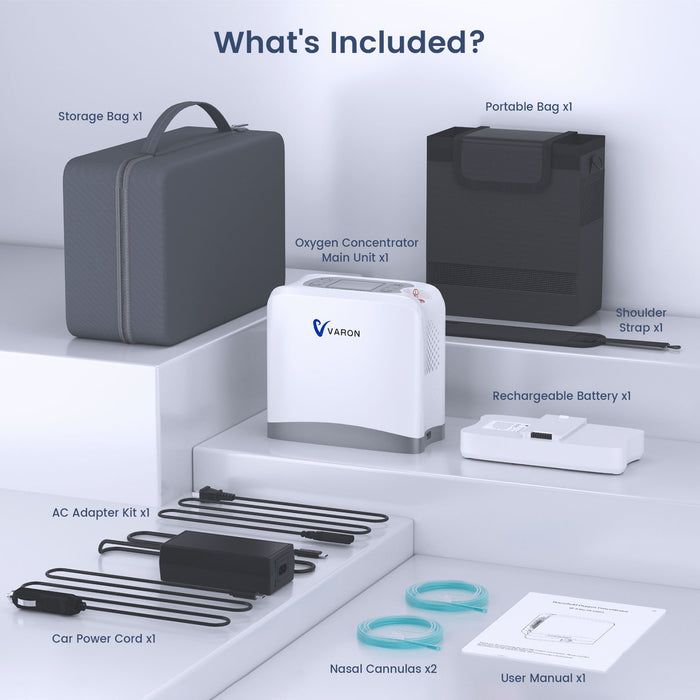
Product-page image of the VP-8G and listed accessories; it is not a separate weighing test.
Think Beyond Pounds: Shape, Bag, and Access
Consider the full setup you would take to a family gathering or a nearby café: the concentrator, installed battery, approved carrying case, strap, and any accessories needed for that outing. The shape of the case, the position of the handle, and access to the display can matter as much as a small difference in listed pounds. Make sure the manufacturer-approved carrying arrangement leaves required vents and connections unobstructed; an ordinary third-party bag is not automatically compatible.
A shoulder strap might be easier to manage for a short visit, while an integrated handle can be convenient when moving the unit from one room to another. Check what the selected bundle actually includes before picturing that setup as standard. VARON’s lightweight portable oxygen concentrator guide goes deeper into weight and carrying considerations.
Battery Life: Read the Conditions, Not Just the Headline
Runtime Depends on the Model and Listed Conditions
“Up to” runtime is a ceiling stated for particular conditions, not a guarantee for every setting. Battery time can vary by model, delivery mode, setting, battery configuration, and operating conditions. Two numbers should not be treated as a head-to-head test unless the source gives comparable conditions.
For example, VARON lists 1.5–5 hours ±15% for the VP-8 Lite across settings 7 through 1. The VP-8G page lists up to 4 hours. The VP-6 page lists up to 2 hours. The VP-2 FAQ lists up to 3.5 hours for its standard battery and up to 6 hours for an optional larger battery. These figures use different product descriptions and conditions, so they should not be used to rank the models by runtime alone.
A useful comparison records five fields:
Model
Battery information
Published runtime
VP-8 Lite
6400 mAh / 92.16 Wh listed
1.5–5 hours ±15%
VP-8G
6700 mAh / 96.48 Wh listed
Up to 4 hours
VP-6
114 Wh / 5200 mAh listed
Up to 2 hours
VP-2
Standard and optional larger battery versions are described; check the selected configuration
Up to 3.5 hours standard; up to 6 hours optional larger battery
For the VP-2, match each published runtime to the standard or optional battery specified for the selected package. If the battery version is unclear, check the current manual or ask VARON to confirm it before relying on a runtime figure.
Standard Batteries, Extra Batteries, and Package Contents
A replaceable battery can make an afternoon away from an outlet easier to plan, provided the specific model, bundle, and stated operating conditions support that plan. For example, someone comparing devices for family visits may want to know whether a spare battery is included, how it can be charged, and where it will fit in the carrying case. A spare battery does not increase the runtime of a single installed battery. Always check whether the listed duration applies to the standard or optional battery and whether a separate compatible charger is needed.
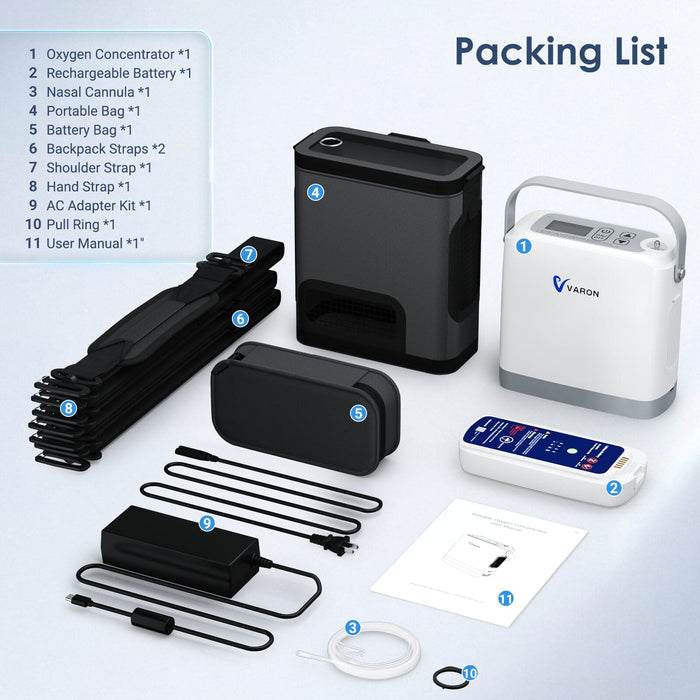
The VP-8 Lite product image illustrates listed package components. Check the live product page for the bundle currently selected.
Power Options for Home, Car, and Time Away
Available power options and included accessories depend on the model and configuration. A product page may mention AC and DC power, but that does not automatically mean every adapter is included or that the device can operate and charge at the same time in every setup.
Power source
Typical situation
What to verify
AC wall power
At home or another place with a compatible outlet
The specified AC adapter, input rating, and whether it is included
DC vehicle power
In a vehicle when the model supports the connection
Manufacturer-specified compatible car adapter, vehicle requirements, and whether operation, charging, or both are supported
Removable battery
Away from a suitable outlet
Compatible battery type, stated runtime at the relevant setting, and availability of spare batteries
AC Power at Home or Work
At home or during desk time, access to a compatible wall outlet may make battery management more convenient. That practical advantage depends on the model’s supported setup and the manufacturer-specified AC adapter—not a generic charger with a similar-looking plug. Check the input rating and package list before relying on an outlet-based plan.
DC Car Power and Replaceable Batteries
For a planned drive to visit friends or family, an officially supported vehicle-power option can be worth checking before departure. Confirm three separate details in the product page and manual: whether the unit supports DC vehicle power, whether the exact cable is supplied in the selected bundle, and whether the intended setup supports operation, battery charging, or both. Having a car cable listed does not establish universal vehicle compatibility or simultaneous use and charging.
Small Details That Affect Everyday Comfort
Noise Levels in Quiet Places
Noise ratings need their stated conditions. VARON lists the VP-8G at ≤40 dB at setting 1, while the VP-8 Lite page gives a 45–60 dB range across settings 1–7. Those are not equivalent test conditions, and the units are not presented in precisely the same way across every model. They should not be used as a simple “quietest model” ranking.
A machine may blend into background conversation in a busy room yet be more noticeable while someone is reading, watching a movie, or working quietly. Rather than treating one advertised number as a promise of silence, check its measurement conditions and think about where the unit would sit during normal indoor activities. A noise claim does not establish suitability for sleep or a particular oxygen-delivery requirement.
Screen Readability, Alerts, and Carrying Accessories
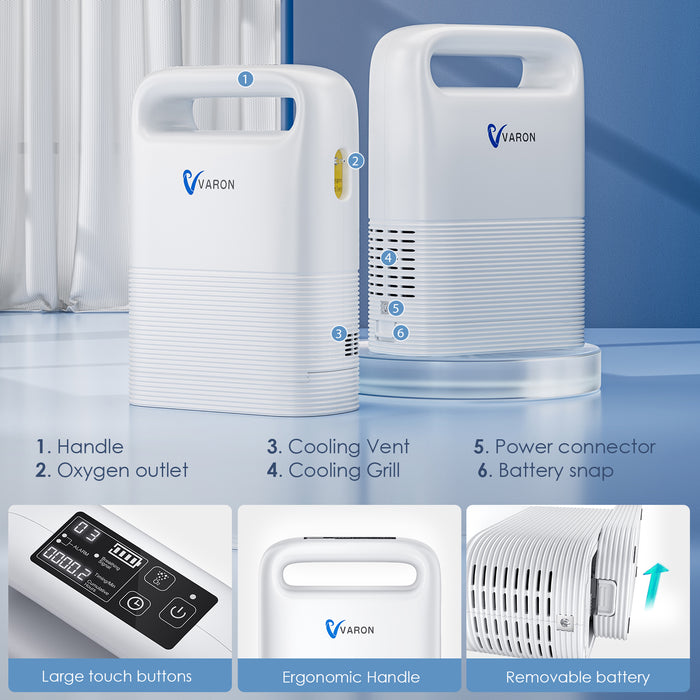
During an ordinary day, being able to glance at the battery indicator or find a clearly marked button can be more useful than a long list of abstract features. Official close-up photos help show where controls, handles, and power connections are located. For actual alert meanings and operating restrictions, rely on the model’s user manual rather than assuming a particular alert function from an image.
Official product-detail image of the VP-2; use the current manual for operating instructions and alert meanings.
Filters, Maintenance, and Warranty Basics
Before buying, identify the parts that need routine care, where compatible replacement accessories are listed, and how to find the current warranty terms. The product’s package list tells you what is included; the accessory page shows what may be purchased separately; and the manual provides model-specific instructions. These sources answer different questions, so one should not be used as a substitute for another.
VARON maintains a manuals page with model-specific documents. Check it alongside the selected product page, and confirm replacement-battery, filter, and carrying-bag availability before assuming that every item is included or interchangeable.
Match the Features to Your Everyday Routine
Your regular schedule is a useful way to decide which convenience features deserve attention. A few errands may put carrying design first, while time at home may make clear controls and accessible power connections more relevant. These lifestyle considerations help compare models only after checking each product’s intended use; they do not establish an appropriate oxygen-delivery mode.
Everyday situation
Features worth comparing
Specific details to verify
Errands and short visits
Carrying weight, bag design, battery runtime
Whether weight includes the battery; runtime at the listed setting
Desk time or time at home
AC power, display, published noise level
Correct adapter, noise-rating conditions, and access to controls
Road trips
DC power, battery plan, included cables
Model-specific vehicle adapter and whether operation or charging is supported
Helping a family member compare
Display and controls, maintenance, documentation
Included accessories, manual availability, replacement parts, and current warranty terms
Comparing VARON Portable Models Without Overcomplicating It
Four VARON models illustrate why choosing by one headline number is difficult. The VP-8G and VP-8 Lite list portable pulse-flow designs with batteries and carrying accessories, so their complete carrying configurations are worth comparing for errands and visits. The VP-6 is listed as continuous flow, while the VP-2 is a separate pulse-flow option with vehicle-power accessories described on its product page. The table keeps the different modes and published conditions visible rather than ranking models by lifestyle or implying that they are interchangeable.
If a model’s intended use and specifications match the requirements you need to check, the next questions are everyday ones: What is included in the carrying setup? Where will you charge or power it? How accessible are the controls? Explore VARON’s portable collection to review current configurations and accessories before choosing.
A Simple Checklist Before You Buy
Use this checklist beside the current product page and manual. Save or print it if you are comparing several models.
Is the delivery mode described clearly, and have I avoided comparing pulse settings directly with continuous-flow liters per minute?
Does the listed weight include the installed battery? Which bag, straps, or other accessories will actually be carried?
What battery type and setting are associated with the stated runtime? Is the figure an “up to” value?
Which AC and DC power options are officially supported, and which adapters are included in the selected package?
Are a spare battery, replacement filters, and a carrying bag included or sold separately?
Are the noise-rating setting and measurement notation provided?
Can I find the latest manual, maintenance instructions, replacement accessories, support contact, and current warranty terms?
If flying, have I checked the exact device, airline rules, and battery requirements separately?
Also compare the likely ownership costs without guessing at future prices: check current listings for replacement batteries, filters, carrying accessories, and any separate charger. Availability and package contents can change, so verify them on the current US product page.
Frequently Asked Questions
Does a lighter portable oxygen concentrator always have shorter battery life?
No. Weight alone does not predict runtime. Battery capacity, delivery design, operating settings, and product configuration all matter. Compare the weight basis and runtime conditions shown on each model page, then check the manual if the product listing does not specify a setting or battery version.
Does advertised battery runtime always refer to the standard battery?
Not necessarily. A page may list a standard battery, an optional larger battery, or a bundle with additional batteries. For example, the VP-2 page describes standard and optional larger batteries separately. Confirm the exact battery and package contents before comparing runtime claims.
Can a portable oxygen concentrator use power from a car?
Some models list compatible DC vehicle power, but the cable, vehicle requirements, and supported operating or charging arrangements vary. Check the selected model’s “Power Supply” and “Package List” fields, then confirm the instructions in its manual. Do not assume that every vehicle adapter is interchangeable.
What does a pulse-flow setting number mean?
It is a model-specific setting, not an automatic equivalent of the same number in liters per minute of continuous flow. VARON’s product pages identify the VP-8G, VP-8 Lite, and VP-2 as pulse-flow models and the VP-6 as continuous flow. Compare the delivery descriptions, not just the setting numbers.
Final Thoughts
The most useful comparison is the one that fits an actual routine. Think about taking the unit along for an afternoon visit, using its controls at home, or checking available power during a road trip. Then confirm the practical details behind those moments: the full carrying weight, stated battery conditions, appropriate power accessories, and included parts. Keep the manufacturer’s intended-use instructions separate from convenience claims. The result is a clearer way to browse product features without treating any single number—or a lifestyle preference—as proof that a model is right for a particular health-related purpose.





Leave a comment