Choosing between an oxygen concentrator and an oxygen tank can feel confusing, especially when you start comparing equipment size, oxygen supply, portability, and daily maintenance.
An oxygen concentrator works differently from a traditional oxygen tank. A concentrator draws in surrounding air, separates oxygen from other gases, and delivers concentrated oxygen through the connected tubing. Home concentrators generally operate from household electricity, while portable models may also use rechargeable batteries.
An oxygen tank, by comparison, stores compressed oxygen inside a cylinder. Tanks are available in different sizes, and smaller tanks generally contain less oxygen than larger ones. The appropriate size depends on the user's oxygen requirements and expected duration of use.
So, which option makes more sense?
The answer depends less on which device looks more powerful and more on how the oxygen will be used, the required flow and delivery method, available power, portability needs, and how the equipment fits into the user's daily routine.
Oxygen Concentrator vs Oxygen Tank: The Basic Difference
The biggest difference is how oxygen is supplied.
An oxygen tank contains a finite amount of compressed oxygen. Once the supply is depleted, the cylinder needs to be replaced or refilled through the appropriate oxygen supplier. A tank does not need electricity to contain the stored oxygen.
An oxygen concentrator does not store a large supply of oxygen in the same way. Instead, it continuously processes surrounding air while operating. Because of this, a concentrator generally needs a power source to function.
Quick Comparison
| Feature |
Oxygen Concentrator |
Oxygen Tank |
| Oxygen source |
Processes surrounding air |
Stores compressed oxygen |
| Supply |
Produces oxygen while operating |
Finite stored supply |
| Electricity |
Required for operation |
Not required to store oxygen |
| Refilling |
Generally not required in normal operation |
Tank must eventually be replaced or refilled |
| Home use |
Stationary models are designed for extended home use |
Can be used at home |
| Portability |
Portable models available |
Smaller tanks can be carried or transported |
| Power outage consideration |
Requires a backup plan |
Stored oxygen remains available |
| Size considerations |
Based on device dimensions and specifications |
Oxygen tank sizes vary by cylinder capacity |
| Best comparison point |
Flow, delivery mode, power, weight and features |
Cylinder size, remaining supply, flow and portability |
The American Lung Association notes that home oxygen concentrators generally deliver oxygen continuously and require an electrical outlet, while compressed oxygen tanks come in different sizes.
An oxygen concentrator uses a different approach from an oxygen tank.
Instead of storing all the oxygen needed for use inside a cylinder, it takes in room air and separates oxygen from other gases before delivering the concentrated oxygen through tubing.
This makes concentrators particularly practical for users who spend long periods at home and have access to a reliable power source.
Home concentrators can also include features designed around everyday comfort, such as:
- Continuous-flow oxygen delivery
- Adjustable flow settings
- Humidification
- Remote controls
- Sleep modes
- Timers
- Wheels or casters
- Nebulization functions on selected models
- Lower-noise operation on selected models
However, not every concentrator provides the same flow range or delivery method. The device should therefore be selected according to the user's oxygen requirements rather than simply choosing the model with the highest number.
What Is an Oxygen Tank?
An oxygen tank is a cylinder that stores compressed oxygen.
Unlike a concentrator, it already contains the oxygen that will be delivered to the user. The amount available depends on the cylinder's size and remaining pressure.
This is where oxygen tank sizes become important.
A smaller cylinder may be easier to carry, but it contains less oxygen. A larger cylinder can hold more oxygen but is generally less convenient to move.
The American Lung Association specifically notes that oxygen tanks come in different sizes and that smaller tanks contain less oxygen.
Understanding Oxygen Tank Sizes
There is no single "best" oxygen tank size for everyone.
When comparing oxygen tank sizes, consider:
- Required oxygen flow
- Expected duration of use
- How frequently the tank will be transported
- Available storage space
- Whether the tank is primarily for home or mobile use
- How often replacement or refilling is available
A larger tank is not automatically better. Similarly, choosing the smallest tank simply because it is easier to carry may not provide enough operating time for the intended routine.
Important: Tank capacity and usable duration depend on the specific cylinder, pressure, flow setting, and equipment configuration. Always use the specifications supplied with the tank rather than estimating runtime from size alone.
Oxygen Concentrator vs Oxygen Tank: Which Is Better at Home?
For primarily home-based use, a stationary oxygen concentrator can be convenient because it can continue producing oxygen while connected to household power.
This can eliminate the need to keep replacing a tank simply because the stored supply has been used.
A tank, however, has an important advantage during a power interruption: it contains stored oxygen and does not depend on electrical power to release that stored supply.
That means the two systems can serve different roles.
A Concentrator May Be More Practical When:
- Oxygen is primarily needed at home.
- Long periods of use are expected.
- Household electricity is readily available.
- Continuous-flow operation is required.
- The user wants to avoid depending entirely on stored oxygen.
- Features such as humidification, remote controls, or sleep mode are useful.
An Oxygen Tank May Be Useful When:
- Stored oxygen is preferred for a particular situation.
- A backup oxygen supply is needed.
- Electricity is unavailable or interrupted.
- A suitable tank size is practical for the intended duration.
- The user already has an established tank supply system.
For many households, the comparison does not necessarily have to mean choosing only one. A concentrator may serve as the primary home device while an appropriate backup arrangement provides additional flexibility.
Home Oxygen Concentrator Examples
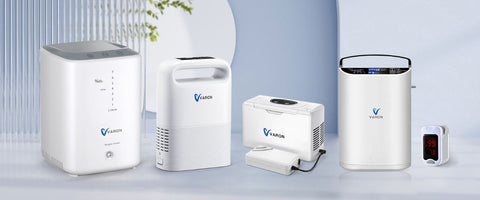
If a concentrator is being considered, compare models based on flow range, delivery type, size, noise, and practical features. For example:
| Model |
Flow Rate |
Delivery |
Notable Features |
| VARON Serene 5 |
0.5–5 L/min |
Continuous |
Humidification, LCD, nebulizer, caster wheels |
| VARON Serene 3 |
1–10 L/min |
Continuous |
Humidification, LCD, nebulizer, caster wheels |
| VARON VH-2 Pro |
1–8 L/min |
Continuous |
Built-in humidifier, remote, nebulization |
| VARON VH-3 |
1–7 L/min |
Continuous |
Sleep mode, <42 dB, humidification, remote |
| VARON VH-4 |
1–9 L/min |
Continuous |
Humidifier, remote, timer, caster wheels |
The important point: These models illustrate how home concentrators can differ in flow range and features. The right choice should be based on the user's oxygen requirements and practical needs rather than simply choosing the model with the highest flow range.
Which Is Easier to Manage: Oxygen Tank or Concentrator?
This depends on what "easy" means for the user.
An oxygen tank has a straightforward concept: the oxygen is already stored inside the cylinder. The user needs to monitor the remaining supply and arrange replacement or refilling when necessary.
A concentrator requires electricity and routine equipment care, but it does not depend on a finite cylinder supply during normal operation.
For someone spending most of the day at home, the convenience of an electrically powered concentrator may outweigh the need to manage tanks.
For someone concerned about power interruptions, a stored oxygen supply can provide a different kind of convenience.
The American Lung Association recommends checking the tank gauge to ensure enough oxygen remains and following the instructions provided for the oxygen equipment.
What About Power Outages?
This is one area where the difference between an oxygen concentrator and an oxygen tank becomes particularly important.
A concentrator depends on electricity to operate. If household power is interrupted, the machine cannot continue producing oxygen unless an appropriate backup power solution is available.
An oxygen tank, on the other hand, already contains stored oxygen.
For households using a concentrator, it is therefore sensible to think about:
-
Backup power
-
A suitable backup oxygen arrangement
-
Emergency contact information
-
Battery options for compatible portable equipment
-
Local power outage risks
-
How long the backup solution can realistically support the user's routine
The American Lung Association also notes that people using home concentrators may receive a larger metal tank as a backup in case of power failure.
Which Is Better for Mobility?
An oxygen tank can be transported, but the size and weight of the cylinder become important.
This is where oxygen tank sizes matter considerably.
A small tank may be easier to carry but has a smaller stored supply. A larger tank may provide more stored oxygen but can be more cumbersome.
Portable oxygen concentrators offer a different approach because they process surrounding air rather than relying on a finite stored cylinder supply. Some portable concentrators operate using batteries, while delivery can be continuous flow, pulse flow, or both depending on the model.
The key is to compare the actual delivery method and flow capability rather than assuming that every portable concentrator works the same way.
What About Nighttime Use?
For users who primarily need oxygen while sleeping at home, a stationary concentrator may be practical because it can remain in one location and operate from household power.
Noise can also become more noticeable at night.
For example, the VARON VH-3 is listed with sleep mode and noise below 42 dB, making those features relevant when comparing home equipment for a bedroom setup.
However, a quieter device does not automatically make it the right choice. Flow range and delivery method should remain the first considerations.
Oxygen Tank vs Oxygen Concentrator: What Should You Choose?
Instead of asking which one is universally better, consider the following:
Choose the equipment based on:
1. Oxygen requirements
Does the device provide the required flow and delivery method?
2. Duration of use
Will the equipment be needed for short periods or long stretches throughout the day?
3. Power availability
Can the concentrator remain connected to reliable electricity?
4. Mobility
Will the equipment stay at home or need to move between locations?
5. Backup needs
What happens if the power goes out or the primary oxygen supply becomes unavailable?
6. Equipment size
For tanks, compare oxygen tank sizes and stored capacity. For concentrators, consider physical dimensions and weight.
7. Daily convenience
Consider noise, controls, wheels, humidification, battery options and maintenance.
Illustrative User Experiences
“For home use, I would rather have a setup that is easy to keep running throughout the day than constantly think about how much oxygen remains in a tank.”
— Illustrative home oxygen user experience
“When comparing oxygen tanks, size matters because a smaller cylinder is easier to move, but I also need to think about how long the oxygen will last.”
— Illustrative caregiver perspective
“For nighttime use, I would compare more than flow rate. Noise, controls, placement and how easy the equipment is to move around the bedroom all matter.”
— Illustrative user perspective
FAQs
Is an oxygen concentrator better than an oxygen tank?
Neither is automatically better. A concentrator produces concentrated oxygen while operating and requires power, while a tank stores a finite supply of compressed oxygen. The better option depends on oxygen requirements, duration, mobility, power availability and backup needs.
How are oxygen tanks different from oxygen concentrators?
An oxygen tank stores compressed oxygen inside a cylinder. An oxygen concentrator processes surrounding air to produce concentrated oxygen while it is operating.
What are oxygen tank sizes?
Oxygen tanks are available in different cylinder sizes. Smaller tanks generally contain less oxygen, while larger tanks hold more. The appropriate size depends on the user's requirements, flow and expected duration of use.
Does a larger oxygen tank last longer?
Generally, a larger cylinder contains more oxygen than a smaller one, but actual operating time depends on the cylinder's capacity, pressure, flow setting and equipment configuration.
Does an oxygen concentrator need electricity?
Yes. Home oxygen concentrators require an electrical power source to operate.
What happens to an oxygen concentrator during a power outage?
A standard electrically powered concentrator cannot continue producing oxygen without power. A suitable backup plan should therefore be considered for users who depend on continuous oxygen support.
Is an oxygen tank easier to use during a power outage?
A tank contains stored oxygen and does not require electricity to release that stored supply, making it a possible part of a backup arrangement.
Is a portable oxygen concentrator the same as an oxygen tank?
No. A portable oxygen concentrator produces concentrated oxygen from surrounding air, while a tank carries a finite supply of compressed oxygen.
Which is better for home use: an oxygen tank or concentrator?
For extended home use, a stationary concentrator can be convenient when reliable electricity is available. An oxygen tank may provide useful stored oxygen and can also serve as part of a backup arrangement.
Can I choose an oxygen concentrator based only on its maximum flow rate?
No. The maximum flow rate is only one specification. Delivery method, operating range, oxygen concentration, power requirements, noise and intended use should also be considered.
Is the VARON VH-3 a good alternative to an oxygen tank?
The VH-3 is a home continuous-flow concentrator with a 1–7 L/min flow range, sleep mode, automatic humidification and listed noise below 42 dB. Whether it is a suitable alternative depends on the user's individual oxygen requirements and equipment needs.
Can oxygen tanks and oxygen concentrators be used together?
They can serve complementary roles in some home oxygen setups, such as using a concentrator as the primary device and having an appropriate stored oxygen supply available for backup. The specific setup should be discussed with the relevant healthcare professional and oxygen supplier.
Final Thoughts
The choice between an oxygen concentrator vs oxygen tank comes down to more than equipment size.
An oxygen concentrator can provide a convenient long-term source while connected to power, making stationary models particularly practical for many home routines. An oxygen tank stores a finite supply and offers independence from household electricity, but the user must monitor the remaining supply and arrange replacement or refilling.
When comparing oxygen tank sizes, remember that smaller cylinders are easier to transport but generally hold less oxygen. Larger cylinders can provide more stored oxygen but may be less convenient to move.
For a home concentrator, compare the flow range, delivery method, oxygen concentration, noise, weight, controls, humidification, mobility and power requirements.
For VARON's home range, the Serene 5 is positioned as the strongest overall option for higher-demand home use, while the Serene 3, VH-2 Pro, VH-3 and VH-4 offer different combinations of flow range, portability, comfort and convenience features.
The most important point is simple: don't choose equipment based only on tank size, concentrator size or maximum flow. Choose the setup that matches the user's oxygen requirements and fits their everyday routine.





Leave a comment