Buying an oxygen concentrator for the first time can feel overwhelming. During major Prime Deals and promotional periods, the number of discounts, bundles, specifications, and product options can make the decision even harder.
A discounted price may catch your attention first, but price should not be the first specification you compare.
Before purchasing, you need to understand what type of oxygen delivery you need, what flow or setting range the machine provides, whether you need a home or portable design, and which features actually matter for your daily routine.
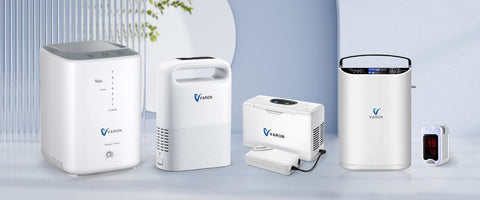
VARON's US range includes both stationary and portable oxygen concentrators, with different flow types, sizes, battery options, and operating features.
This guide walks first-time buyers through the most important things to check before purchasing an oxygen concentrator during Prime Deals.
What Should First-Time Buyers Look for in an Oxygen Concentrator?
Before looking at the discount, start with these questions:
- Do I need continuous flow or pulse flow?
- What oxygen setting do I need?
- Do I need a home or portable machine?
- What oxygen concentration is specified at the setting I need?
- Do I need battery operation?
- How important are weight and portability?
- What power options are available?
- What accessories or batteries are included?
- What warranty and return terms apply?
- Is the discounted price actually valuable for my intended use?
Your individual oxygen requirements should be established with a qualified healthcare professional. A sale price should never be the reason to change your oxygen setting or delivery method.
1. Start With Your Oxygen Delivery Type
The first major decision is continuous flow vs. pulse flow.
These are different oxygen delivery methods and should not be treated as interchangeable.
Continuous Flow
A continuous-flow concentrator provides oxygen continuously while operating.
VARON's US lineup includes several continuous-flow models, including:
Pulse Flow
Pulse-flow concentrators deliver oxygen in pulses rather than as a continuous stream.
VARON portable models include:
The important thing for a first-time buyer is not to compare a pulse setting directly with a continuous-flow L/min number.
For example, "5 pulse settings" does not mean the same thing as "5 L/min continuous flow."
2. Know Your Required Oxygen Setting Before Shopping
A common mistake is to browse products first and decide on an oxygen setting afterward.
Instead, start by knowing the oxygen delivery requirements recommended for you.
For continuous-flow equipment, you may see specifications such as:
- 0.5–5 L/min
- 1–6 L/min
- 1–7 L/min
- 1–8 L/min
- 1–10 L/min
For pulse-flow equipment, you may see:
- 1–5 settings
- 1–7 settings
- 1–8 settings
The machine's maximum setting is not a recommendation for how much oxygen you should use.
For example, a concentrator capable of 1–10 L/min does not mean every user should operate it at 10 L/min.
Choose a machine whose specifications accommodate your individual requirements, and follow the guidance provided by your healthcare professional.
3. Understand Oxygen Concentration
Another important specification is oxygen concentration.
You may see a product advertised with a percentage such as 90% or 93% ±3%.
However, don't compare these percentages without looking at the conditions attached to the specification.
For example, VARON's current US product information lists:
| Model |
Flow / Output |
Listed Oxygen Concentration |
| Serene 5 |
0.5–5 L/min continuous |
93% ±3% |
| Serene 3 |
1–3 L/min continuous |
93% ±3% |
| VH-2 Pro |
1~9L/min continuous flow (Adjustable)
|
38%-96%
|
| VP-6 |
1–6 L/min continuous |
93% ±3% at 1 L/min |
| VP-8G |
1–8 pulse settings |
93% ±3% |
| VP-8 Lite |
1–7 pulse settings |
90% |
These specifications demonstrate why you should look at flow and concentration together rather than choosing a machine based on the largest percentage shown on a product page.
4. Home Oxygen Concentrator or Portable Oxygen Concentrator?
The next question is where you plan to use the machine.
Choose a Home-Focused Design When You Primarily Use Oxygen at Home
A stationary concentrator can be practical when you expect the machine to remain in your home.
VARON's home and stationary range includes models such as the:
For these machines, factors such as continuous-flow range, noise, humidification, nebulizer functions, controls, and mobility around the home may matter more than battery capacity.
For example, the Serene 5 provides 0.5–5 L/min continuous flow, 93% ±3% oxygen concentration, a humidification system, nebulizer function, LCD display, and caster wheels.
Choose a Portable Design When Mobility Is a Priority
Portable models are designed around different priorities.
You may care more about:
- Weight
- Battery runtime
- Replaceable batteries
- AC power
- DC car power
- Carrying options
- Size
- Ease of operation
The VARON VP-8G, for example, weighs 4.37 lbs, provides 1–8 pulse settings, uses a removable battery, and supports AC and car power.
5. Compare Weight Before Buying a Portable Model
A product can look compact on a product page but feel very different when carried for an extended period.
Current VARON US portable models include:
| Model |
Delivery |
Weight |
| VL-1 |
Pulse |
3.08 lbs |
| VL-2 |
Continuous |
3.3 lbs |
| VP-8G |
Pulse |
4.37 lbs |
| VP-8 Lite |
Pulse |
4.4 lbs |
|
VP-6
|
Continuous |
7.9 lbs |
For someone who regularly moves around, the difference between a 3.3-lb and 7.9-lb device can be significant.
But the lightest device is not automatically the right choice.
You still need to confirm that its delivery method and specifications match your individual requirements.
6. Check Battery Capacity and Runtime
Battery information is particularly important for portable oxygen concentrators.
Consider both:
Battery capacity and actual listed runtime.
For example:
- 96.48Wh removable battery
- Up to 4 hours
- Replaceable battery
- AC and DC car power
- 92.16Wh replaceable battery
- 1.5–5 hours listed battery range
- AC and DC car power
- About 3 hours charging time
- 114Wh replaceable battery
- Up to 2 hours
- AC and DC car power
Battery runtime can vary according to the selected setting and operating conditions, so don't assume that a battery's Wh rating directly equals a specific number of hours.
7. Think About How You Will Use the Machine
Before buying during Prime Deals, imagine a normal day rather than focusing only on the product page.
Mostly at home?
Look closely at:
- Continuous-flow range
- Noise
- Controls
- Humidification
- Nebulizer functions
- Wheels
- Long-duration operation
Regularly leaving the house?
Consider:
- Weight
- Battery runtime
- Replaceable batteries
- Carrying options
- AC/DC power
Spending time in the car?
Check whether the model supports DC car power and review the manufacturer's power requirements.
Moving between rooms?
Caster wheels or a lighter design may be useful depending on the model.
The best specifications are the ones that solve your actual everyday requirements.
8. Don't Buy Based on the Discount Percentage Alone
A Prime Deal may show a large percentage discount, but a cheaper machine isn't necessarily the better purchase if its specifications don't match what you need.
Instead, calculate the value based on the features you will actually use.
For example:
Price → Features → Specifications → Daily use → Long-term value
Not:
Discount → Buy immediately
During a major sale, compare the regular price, sale price, included accessories, battery configuration, warranty, return policy, and any bundle contents.
9. Check What Comes With the Machine
Two products can have similar prices but very different packages.
Before purchasing, check whether the offer includes:
- Main concentrator
- Battery
- Additional battery
- AC adapter
- Car/DC adapter
- Carrying bag
- Nasal cannula
- Filters
- Other accessories
This is especially important when comparing a standard product with a promotional bundle.
For example, VARON currently offers different configurations for some portable products, including VP-8G configurations and VP-8 Lite bundle options.
10. Consider a Battery Bundle for Portable Use
If you are considering a portable oxygen concentrator, an additional battery can be more useful than paying for a feature you don't need.
VARON's US lineup includes a VP-2 All-Day Power Bundle with three rechargeable batteries and a listed 10+ hours of power.
The important thing is to compare the complete package rather than looking only at the headline price.
Ask:
"What am I actually getting for the sale price?"
11. Check Warranty and Return Terms
Price isn't the only financial consideration.
Before purchasing, check:
- Warranty period
- Return window
- Maintenance support
- Battery warranty
- Shipping terms
- Who handles customer service
VARON's US product pages currently advertise a 1-year warranty, while some product pages also list a 30-day refund policy and 30-day price guarantee. Always check the current terms on the specific product page before completing your purchase.
12. Compare These VARON Models During a Sale
Here's a simplified comparison for first-time buyers.
| Model |
Type |
Flow / Settings |
Weight |
Battery |
Key Consideration |
|
VP-8G |
Portable Pulse |
1–8 |
4.37 lbs |
96.48Wh removable |
Lightweight portable design with 8 pulse settings |
|
VP-8 Lite |
Portable Pulse |
1–7 |
4.4 lbs |
92.16Wh |
Lightweight design with 90% concentration |
|
VP-6
|
Portable Continuous |
1–6 L/min |
7.9 lbs |
114Wh |
Portable continuous-flow option |
|
VL-2 |
Portable Continuous |
3 L/min |
3.3 lbs |
2500mAh standard |
Lightweight continuous-flow design |
|
VL-1 |
Portable Pulse |
Max equivalent 3 L/min |
3.08 lbs |
2500mAh standard |
Lightweight pulse-flow design |
|
Serene 5 |
Home Continuous |
0.5–5 L/min |
36.81 lbs |
No battery |
Home-focused continuous-flow design |
| Serene 3 |
Home Continuous |
1–10 L/min |
26 lbs |
No battery |
Broad continuous-flow range |
The purpose of this table is to compare documented product characteristics, not to determine which model is medically appropriate for a particular person.
Which VARON Model Should a First-Time Buyer Compare?
Rather than choosing a single "best" model, start with your intended use.
If portability is your priority
Compare the VP-8G, VP-8 Lite, VL-1, and VL-2 based on their delivery method, weight, battery, and specifications.
If you need portable continuous flow
Look at the VP-6 and compare its 1–6 L/min continuous-flow range, 7.9-lb weight, and 114Wh replaceable battery with your requirements.
If you primarily need a home machine
Compare models such as the Serene 5, Serene 3, VH-2 Pro, VH-4, and VH-3 according to flow range, oxygen concentration specifications, noise, controls, and home-use features.
If battery flexibility is important
Look at models with removable or replaceable batteries, and compare the standard package with available bundles.
Prime Deals Oxygen Concentrator Buying Checklist
Before clicking Buy, run through this checklist:
Oxygen requirements
Product specifications
Portable models
Purchase
Common First-Time Buyer Mistakes
Buying the cheapest model
A lower price is useful only if the machine meets your requirements.
Choosing the highest flow range
A larger flow range does not mean you should use a higher oxygen setting.
Confusing pulse settings with L/min
A pulse setting and continuous-flow L/min measurement describe different delivery systems.
Ignoring weight
For portable use, a few pounds can make a noticeable difference during daily activities.
Looking only at battery capacity
A larger Wh number does not guarantee a specific runtime. Check the manufacturer's listed runtime and conditions.
Forgetting accessories
A low-priced machine may become less attractive if essential accessories or additional batteries are sold separately.
Buying during a sale without checking the return policy
Promotional periods can create urgency. Take a moment to confirm the current purchase and return terms before ordering.
Frequently Asked Questions
Is Prime Day a good time to buy an oxygen concentrator?
A major promotional period can provide an opportunity to compare discounted prices and bundles, but the discount should not be the only factor. First compare the machine's delivery type, flow/settings, oxygen concentration, portability, battery, included accessories, warranty, and return terms.
What should I check first when buying an oxygen concentrator?
Start with your required oxygen delivery method and setting. Then compare products based on whether they support those requirements.
Should I choose a portable or home oxygen concentrator?
That depends on how you plan to use the equipment. Home models generally focus on stationary use and continuous flow, while portable models place greater emphasis on weight, battery operation, and mobility.
Is a higher oxygen concentration always better?
Do not compare concentration percentages in isolation. Check the manufacturer's stated concentration together with the flow rate and operating conditions.
Is a higher flow rate better?
Not necessarily. The appropriate oxygen setting depends on individual requirements. A higher maximum flow does not mean a higher setting should be used.
What is the difference between pulse flow and continuous flow?
Continuous flow provides oxygen continuously, while pulse flow delivers oxygen in pulses. The settings from these two delivery methods should not be treated as equivalent.
What is more important for a portable oxygen concentrator: weight or battery life?
Both can matter. A lighter device may be easier to carry, while a larger or replaceable battery can provide more flexibility away from a power outlet. The right balance depends on your daily routine.
Should I buy extra batteries during a Prime Deal?
If you use a portable concentrator away from outlets for extended periods, an additional battery may provide useful flexibility. Compare the cost of the battery separately with the cost of a bundle.
Can I change my oxygen setting to take advantage of a different machine?
No. A promotional price or different machine should not determine your oxygen setting. Follow the oxygen setting and delivery method recommended for your individual requirements.
Final Thoughts
Prime Deals can be an attractive time to purchase an oxygen concentrator, but the biggest discount is not necessarily the best value for your situation.
For a first-time buyer, the most useful approach is simple:
Know your requirements → choose the delivery type → check the flow/settings → compare oxygen concentration → consider portability or home use → check battery and power → review the complete package → then compare the price.
VARON's US lineup includes lightweight pulse-flow models such as the VP-8G and VP-8 Lite, portable continuous-flow options such as the VP-6, and home-focused continuous-flow models such as the Serene 5 and Serene 3.
If you're shopping during a Prime Deal, take a few extra minutes to compare the complete product specification and package, not just the sale banner.
Ready to Compare VARON Oxygen Concentrators?
Explore the current VARON US lineup and compare each model's flow type, settings, weight, battery options, and features before making your purchase.
Shop VARON Oxygen Concentrators
Oxygen concentrator settings should be selected according to individual oxygen requirements and guidance from a qualified healthcare professional.





Leave a comment